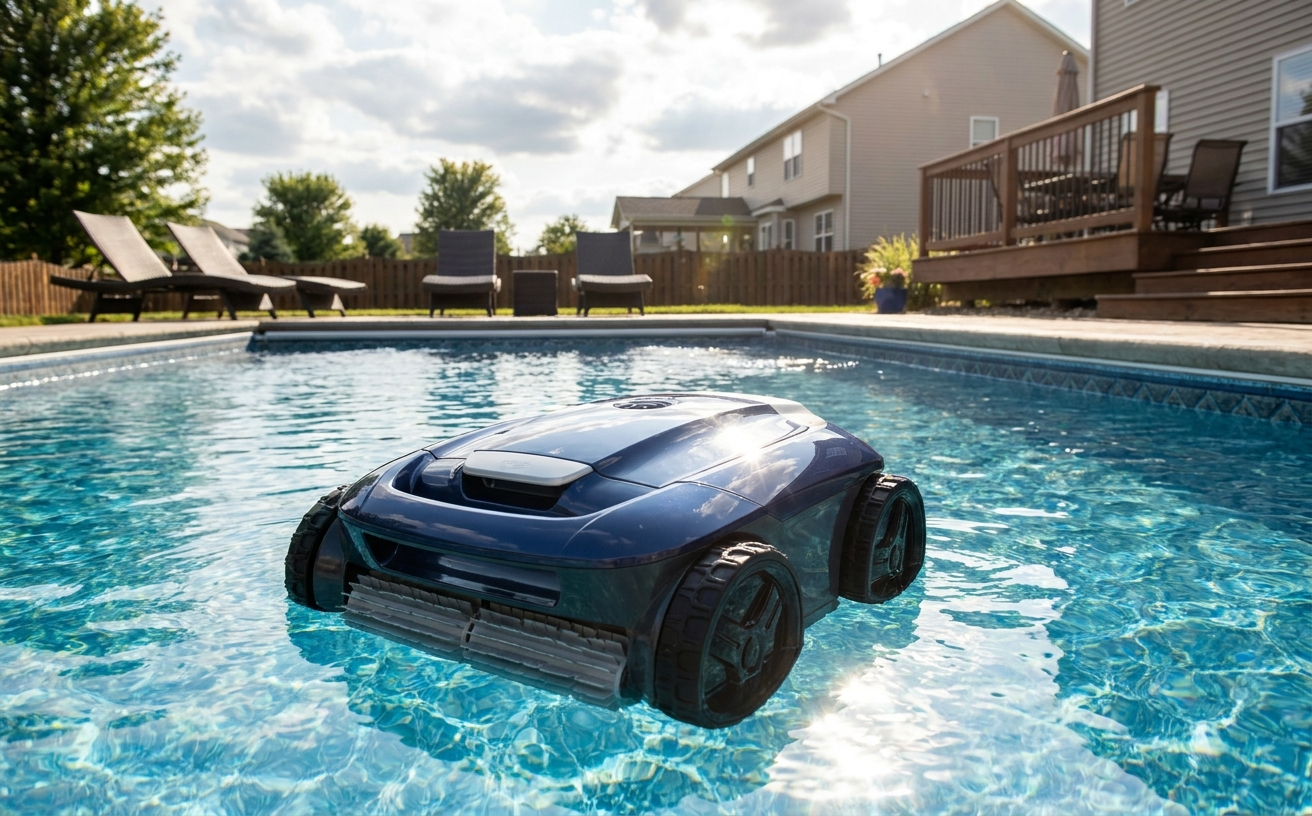
Cordless pool cleaners are the newest category in pool maintenance, and they solve the single most frustrating problem with traditional robotic cleaners: the cable. No more tangles, no more cable catching on ladders, no more coiling and storing twenty-five feet of wet electrical cord after every use. But eliminating the cable introduces a different set of constraints that are less immediately obvious but equally real.
Understanding the trade-offs between cordless and corded cleaners is essential for making a choice that matches your pool, your patience, and your expectations.
What Cordless Cleaners Eliminate
The cable is responsible for the majority of owner frustration with robotic pool cleaners. It tangles during operation, restricting the cleaner’s movement and preventing it from reaching the far end of the pool. It catches on pool features like ladders, lights, and fountains, requiring manual intervention to free it. It must be coiled and stored after each use, which is awkward with a wet, heavy cord.
Cordless cleaners eliminate all of these problems. You place the cleaner in the pool, press a button, and it operates independently without any connection to the surface. When the cleaning cycle is complete, you retrieve it, clean the filter, and put it on the charger. The simplicity is compelling.
The absence of a cable also means there is nothing to trip over on the pool deck, nothing to route around furniture, and nothing to protect from lawnmowers and foot traffic. For pools where the power supply location is awkward relative to the pool, cordless operation removes a logistical constraint entirely.
The Battery Constraint
Cordless cleaners run on rechargeable lithium-ion batteries that provide sixty to ninety minutes of cleaning time per charge. This is the fundamental limitation. A corded cleaner can run indefinitely because it draws power from the outlet. A cordless cleaner stops when the battery depletes.
Sixty to ninety minutes is adequate for small to medium pools but may not be sufficient for large pools or pools with heavy debris loads. If your pool requires two hours of cleaning to achieve full coverage, a cordless cleaner will cover roughly half the pool per charge. You would need to run it twice, with a charging interval in between.
Battery capacity degrades over time. A battery that provides ninety minutes when new may provide only sixty minutes after two seasons of regular use. Replacement batteries are available but add an ongoing cost that corded cleaners do not have.
Suction Power and Filtration
Corded cleaners have unlimited power available and can run larger, more powerful pumps. Cordless cleaners must balance pump power against battery life. Running a high-power pump drains the battery faster, reducing cleaning time. Running a lower-power pump extends battery life but may not provide adequate suction for heavy debris.
For typical residential debris like leaves, insects, and light sediment, cordless cleaners perform adequately. For challenging debris like sand, fine silt, and algae, the lower sustained suction of a cordless cleaner may not capture as effectively as a corded model with a larger pump.
When comparing cordless vs corded pool cleaner performance on fine debris, corded models generally have an advantage because their pumps can operate at maximum capacity for the entire cleaning cycle without battery concerns. Cordless models must manage power consumption to achieve reasonable run times.
Charging and Turnaround Time
After a cleaning cycle, a cordless cleaner needs four to six hours to recharge. This means you can run it once per day at most. If the pool needs cleaning twice because of heavy debris or incomplete coverage, you must wait for the battery to recharge before the second run.
Corded cleaners have no turnaround time. You can run them back-to-back as many times as needed. This matters during peak debris season when a single cycle may not be sufficient.
The charging requirement also means you need a dedicated charging location near an outlet. The charging base takes up space on the pool deck or in a storage area, which is a consideration that corded cleaner owners do not face because the transformer sits in one location permanently.
Weight and Handling
Cordless cleaners carry the weight of the battery pack inside the unit, which makes them heavier out of the water than equivalently sized corded models. The difference is noticeable when lifting the cleaner out of the pool and carrying it to the charging location.
In the water, the battery weight is less significant because buoyancy reduces the effective weight. But during handling, which happens every time you use the cleaner, the additional weight matters. If you have physical limitations or a pool that requires lifting the cleaner up steps or over a raised edge, the weight difference is worth considering.
Some cordless models include built-in handles or caddies that make transport easier. These accessories address the weight issue partially but do not eliminate it.
Long-Term Cost of Ownership
Cordless cleaners typically cost more upfront than comparable corded models because of the battery and charging system. The ongoing cost of battery replacement every two to four years adds to the total cost of ownership.
Corded cleaners have lower upfront costs and no battery replacement costs, but cable replacement is occasionally necessary if the cable is damaged. Cable replacement costs less than battery replacement but is not always available for older models.
Over a five-year ownership period, the total cost difference between cordless and corded models is modest. The more significant factor is whether the convenience of cordless operation is worth the runtime limitation.
Which Pools Benefit Most From Cordless
Small to medium pools with moderate debris loads are the ideal use case for cordless cleaners. The runtime is sufficient for full coverage, and the absence of a cable simplifies the entire experience. Above-ground pools, where cable routing is often awkward, benefit particularly from cordless operation.
Large pools, pools with heavy debris, and pools that need multiple cleaning cycles per day are better served by corded models. The unlimited runtime and higher sustained suction power handle demanding conditions more effectively.
The best choice is the one that matches your specific situation. Cordless is not universally superior or inferior to corded. It is a different set of trade-offs that favor certain pools and frustrate others. Choose based on your pool size, debris load, and tolerance for cable management, and you will be satisfied with either approach.