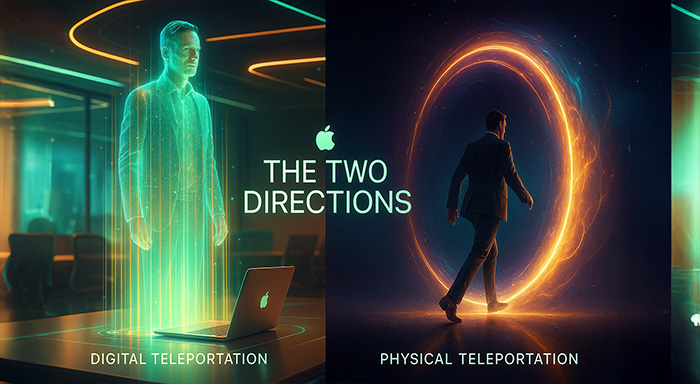
The phrase “Apple teleport machine” sounds like pure science fiction at first glance—but if any company could make feel inevitable, it’s Apple. Known for turning complex technology into everyday experiences, Apple has built its reputation on making the impossible feel obvious in hindsight. From personal computers to smartphones and spatial computing, Apple’s pattern is clear: wait, refine, then redefine the category.
Apple teleport machine, as a concept, sits at the far edge of modern innovation. It’s not just a faster way to travel—it’s a complete rethinking of space, time, and presence. If Apple were ever to enter this domain, it wouldn’t be as a flashy experiment. It would be introduced as a polished, controlled, and deeply integrated ecosystem feature.
In this article, we’ll explore what an Apple teleport machine could look like, how it might work, and why Apple would approach teleportation very differently from anyone else. This isn’t rumor or leaked hardware—it’s a grounded, expert-style exploration of how Apple historically innovates and how that philosophy could apply to Apple teleport machine.
What Is the Apple Teleport Machine Concept?
The Apple teleport machine is a hypothetical device designed to move people or objects instantly from one location to another using advanced physics, quantum mechanics, and Apple’s signature user-focused design philosophy. Unlike sci-fi depictions that involve chaos and danger, Apple’s version would prioritize safety, simplicity, and predictability above all else.
Apple would never frame teleportation as “breaking reality.” Instead, it would likely be positioned as space optimization—a smarter way to transition between environments. Just as Apple reframed MP3 players as iPods and VR headsets as spatial computers, teleportation would get a carefully chosen, friendly name that removes fear from the equation.
Most importantly, the Apple teleport machine wouldn’t be a standalone gadget. It would exist as part of a larger ecosystem, syncing with Apple IDs, biometric authentication, location services, and privacy protocols. Teleportation wouldn’t feel experimental—it would feel managed, intentional, and controlled.
How an Apple Teleport Machine Could Work

From a technical perspective, Apple teleport machine wouldn’t invent teleportation from scratch—it would refine existing theories. The most realistic foundation would be quantum-state reconstruction, where matter is scanned, transmitted as data, and reconstructed at a destination point. Apple’s strength lies in managing extreme complexity behind clean interfaces.
The process might begin with ultra-high-resolution atomic scanning, using AI-powered error correction to ensure perfect reconstruction. Apple already invests heavily in custom silicon and neural processing, so it’s realistic to imagine teleportation relying on Apple-designed chips optimized for quantum data stability and verification.
Crucially, Apple would focus on error prevention. Redundant scans, multiple verification passes, and biometric confirmation would ensure nothing goes wrong. The experience wouldn’t feel like stepping into a risky machine—it would feel like Face ID on a planetary scale: fast, invisible, and reassuring.
Design Philosophy: Apple teleport machine Way
Apple’s design philosophy would shape the Apple Teleport Machine more than the science itself. The hardware wouldn’t look intimidating or industrial. Expect minimalist materials, soft lighting, and a form factor that feels architectural rather than mechanical—something closer to a calm space than a lab experiment.
User interaction would be almost nonexistent. There would be no buttons labeled “Teleport.” Instead, the machine might activate automatically once identity, destination, and safety parameters are confirmed. Apple has always removed steps, and teleportation would be no exception.
Even the emotional experience would be considered. Apple understands that teleportation could feel unsettling, so visual cues, sound design, and haptic feedback would be engineered to reduce anxiety. The goal wouldn’t be to impress—it would be to make teleportation feel boringly reliable.
Privacy, Security, and Ethical Safeguards
If Apple built a Apple Teleport Machine, privacy would be non-negotiable. Teleportation involves the most sensitive data imaginable: a complete physical and biological blueprint of a person. Apple would likely store nothing permanently, relying on encrypted, ephemeral data that disappears instantly after use.
Security systems would go far beyond passwords. Multi-layer biometric verification, on-device processing, and hardware-based encryption would ensure Apple teleport machine can’t be hijacked or misused. Apple’s track record with Secure Enclave suggests this would be a core selling point.
Ethically, Apple would impose strict limitations. Teleportation might initially be limited to short distances, approved destinations, or specific use cases like medical emergencies or corporate travel. Apple tends to roll out radical technology slowly, ensuring public trust before mass adoption.
Potential Use Cases and Real-World Impact
The most immediate impact of an Apple teleport machine would be on global travel. Business meetings, medical procedures, and disaster response could happen instantly. Apple wouldn’t market teleportation as replacing travel—it would frame it as reducing friction in critical moments.
Healthcare could be transformed. Specialists could Apple Teleport Machine to emergency zones, patients could be transported without physical stress, and medical resources could move faster than ever before. Apple has already shown interest in health tech, making this a natural extension.
On a personal level, teleportation would redefine work-life balance. Living in one country and working in another would become trivial. Cities, housing markets, and even cultural exchange would shift. Apple teleport machine wouldn’t just sell a machine—it would quietly reshape how humanity organizes itself.
Why Apple Would Be the Company to Do It
Teleportation requires more than scientific breakthroughs—it requires trust. Apple has spent decades building consumer confidence around safety, reliability, and polish. People don’t just buy Apple teleport machine products because they’re powerful; they buy them because they feel safe using them.
Unlike startups that chase disruption, Apple controls the entire stack: hardware, software, silicon, and services. That level of integration is essential for something as complex as Apple Teleport Machine No loose ends. No third-party dependencies. No unpredictable behavior.
If Apple teleport machine ever becomes real, Apple wouldn’t announce it with hype. It would appear quietly, framed as the next logical step forward. And just like the iPhone, people would eventually wonder how they ever lived without it.
Final Thoughts: Science Fiction Today, Strategy Tomorrow
The Apple teleport machine may not exist—yet—but the idea itself reveals something important. Apple’s true power isn’t invention for its own sake; it’s translation. The company takes raw, intimidating technology and turns it into human experience.
Teleportation sits at the edge of what’s possible, but history shows that edges move. What feels impossible today often becomes mundane tomorrow, especially when guided by companies that value usability over spectacle.
If Apple teleport machine ever leaves the pages of science fiction, don’t expect it to arrive loudly. Expect it to arrive polished, secure, and quietly life-changing—with an Apple logo, a calm interface, and a simple promise: distance no longer matters.